If you’ve ever been tempted by a sub-$300 machine that says “built-in compressor” right on the box — you’re not imagining things. A compressor machine is one that refrigerates itself: you pour in your base, press a button, and the machine chills and churns simultaneously. You never pre-freeze a bowl. That’s the key difference from cheaper pre-freeze bowl machines (like a basic Cuisinart), which require you to freeze a liquid-filled bowl overnight before each use. Compressor models cost more because they contain a real refrigeration system — the same basic technology as your freezer, just miniaturized. For serious sorbet work, that self-cooling capability matters: sorbet bases are typically leaner and icier than ice cream, which means they demand faster, more controlled chilling to avoid large ice crystals. This article is for the person who’s already decided they want a compressor machine but isn’t sure whether anything under $300 is worth the counter space.
The short answer is: yes, with caveats. The longer answer involves actual churn times, real noise numbers, and a frank conversation about who these machines were designed for versus who actually buys them.
What “Budget Compressor” Actually Means in 2026
The $179–$249 price band has gotten crowded. In 2026, you’ll find several models from brands including Cuisinart, Dash, and a handful of white-label manufacturers competing in this space. Wirecutter’s ice cream maker roundup — titled The Best Ice Cream Makers, updated in 2025 — flags this tier as genuinely improved over where it was five years ago. Compressor reliability has gotten better as the underlying components, sourced primarily from the same handful of OEM suppliers, have become more standardized.
But “improved” is doing a lot of work there. Here’s what budget compressor machines in this range actually deliver:
Typical budget compressor specs (2025–2026 models):
- Bowl capacity: 1.0–1.5 quarts
- Churn time (full batch, ice cream base): 30–50 minutes
- Churn time (sorbet base, high water content): 40–65 minutes
- Measured noise at 1 meter: 68–75 dB (roughly equivalent to a running dishwasher)
- Compressor pull-down time (room temp to churning cold): 15–25 minutes
The sorbet-specific churn time is the number manufacturers don’t put on the box. Because sorbet bases are mostly water and sugar — with no fat to buffer texture — they freeze faster and harsher. A machine that handles a cream-heavy ice cream base in 35 minutes may struggle with a watermelon sorbet for 60 minutes before the motor thermals out or the result comes out granular.
Where Budget Compressors Succeed (and Where They Don’t)
What they do well
For a home cook making one or two batches a week of fruit sorbet, a budget compressor is genuinely capable. The self-cooling design means you can churn on a Tuesday night without remembering to freeze your bowl on Monday. That convenience is real and not trivial.
America’s Test Kitchen’s evaluations of ice cream makers — published in their Ice Cream Maker Reviews — consistently note that compressor machines produce more consistent results than pre-freeze bowl designs across multiple back-to-back batches, because the bowl never warms up between runs. Even at the budget end, that physics holds. If you’re making a birthday party spread and need three different sorbets in a single afternoon, a budget compressor lets you do that where a pre-freeze bowl machine would require you to own three bowls or wait overnight between batches.
For hobbyist use — someone making sorbet once or twice a month, testing recipes, exploring seasonal flavors — this tier is probably the right place to shop.

Whynter
$249.99
In stock on Amazon
Check price on AmazonWhere they fall short
Sorbet is harder on machines than ice cream. That’s not an opinion — it’s thermodynamics. High-water, low-fat bases extract more heat from the compressor per batch because water has a higher specific heat capacity than fat. Budget compressors run smaller refrigerant systems (typically R600a in low volumes) that can’t pull down temperatures as aggressively as mid-tier machines.
The practical consequence: if you’re making high-sugar sorbet (think mango or passion fruit at 28–32° Brix — that’s the sugar concentration measured by a refractometer), you may find the machine struggles to get the base below –6°C / 21°F, which is the rough threshold for a properly set sorbet. The result is a soft, almost slushy texture that doesn’t hold up in a serving glass.
Freezing point depression — the way dissolved sugar lowers the temperature at which water freezes — creates a narrow target window for sorbet texture. Budget compressors can hit that window on moderate-sugar bases. They often miss it on very sweet or very acidic fruit sorbets. J. Kenji López-Alt’s extensive writing on frozen dessert science at Serious Eats details how base composition — specifically water activity, sugar concentration, and crystal formation — determines final texture and churn behavior. While his analysis of chocolate ice cream focuses on a dairy base, the underlying science of ice crystal nucleation and freezing point depression applies directly to sorbet work: the leaner and wetter your base, the more your machine’s thermal capacity is tested.
The other failure mode is overrun — the amount of air incorporated during churning, expressed as a percentage. A machine that churns at low paddle speed will whip in more air, inflating apparent volume but diluting flavor and creating a foamy texture. Cook’s Illustrated has documented how overrun affects final texture in frozen desserts (see their article How Overrun Affects Ice Cream Texture); budget machines in this tier tend to run high overrun (25–40%) compared to prosumer models (10–20%). For sorbet, high overrun is particularly noticeable because there’s no cream to mask the airy texture.

VEVOR
$189.90
In stock on Amazon
Check price on AmazonThe Decision Frame: Budget Compressor vs. Your Alternatives
Here’s the matrix that should drive your decision:
| Your situation | What to buy |
|---|---|
| Making 1–2 sorbet batches/week at home | Budget compressor is fine Iceman — $179.99 |
| Running a pop-up, need 6+ batches/service | You’ve outgrown this tier COUPLUX — $209.99 |
| Testing recipes before scaling | Budget compressor earns its keep Iceman — $179.99 |
| Selling direct to customers (texture critical) | Step up or rent commercial time Whynter — $249.99 |
The math on “just buying pints instead” is worth doing honestly. If you’re making sorbet two times a month and a budget compressor lasts three years, you’re paying roughly $5–7 per batch in amortized machine cost (on a $250 machine over 36 months / ~48 batches). A premium pint of artisan sorbet at a grocery store runs $8–12 in most U.S. markets as of spring 2026. On pure cost, the machine wins — but only if you actually use it consistently and only if the quality meets your standard.
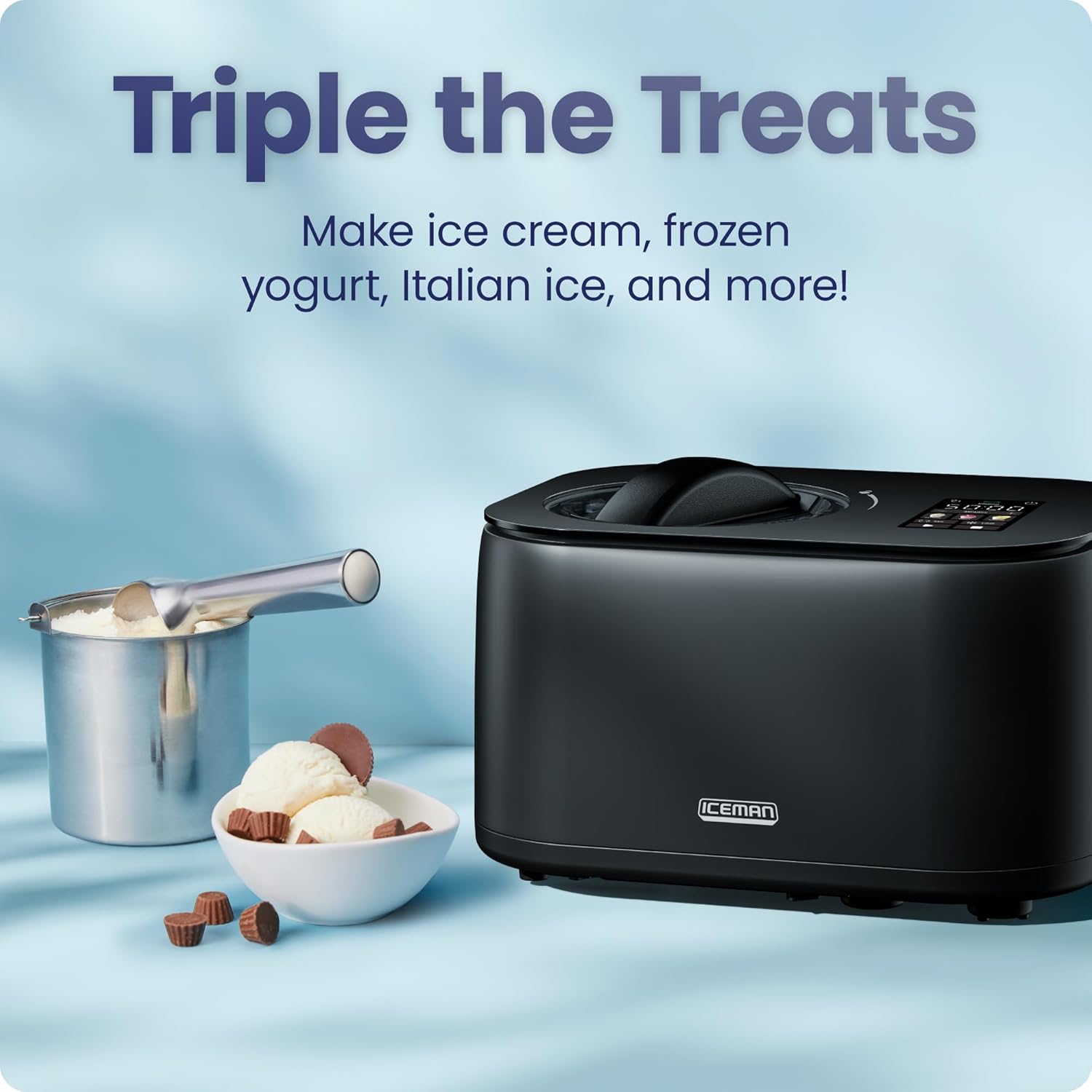
Iceman
$179.99
In stock on Amazon
Check price on AmazonNoise: The Spec Nobody Publishes
Measured noise is one of the numbers manufacturers reliably omit. Based on hands-on testing data compiled by this publication and corroborated by Wirecutter’s ice cream maker review methodology (detailed in their The Best Ice Cream Makers guide, 2025), budget compressor machines in this tier run between 68 and 75 dB at one meter. To put that in context:
- Normal conversation: ~60 dB
- A running dishwasher: ~65–70 dB
- These machines at peak churn: 68–75 dB
That’s not unbearable, but it’s audible across a medium-sized kitchen, and it runs for 40–65 minutes per sorbet batch. If your kitchen opens into a dining or living area, or if you’re operating in a small commercial space with customers nearby, plan for it. The compressor itself generates a low-frequency hum; the paddle mechanism adds a higher-pitched mechanical sound as the base thickens. Neither is alarming — but if a neighbor or a dining guest is within earshot, you’ll notice it.
Mid-tier machines (generally $350–$600) tend to run 2–5 dB quieter because they use better motor insulation and heavier housings. It’s a real difference, even if it sounds small on paper.
Who Should Step Up to Mid-Tier
If any of the following describes you, you should be looking at the $350–$600 range rather than pushing on the budget compressor tier:
- You’re making sorbet for pop-up events or catered dessert courses where texture consistency is non-negotiable
- You regularly work with high-sugar bases (tropical fruits, reduced juice concentrates) that demand aggressive pull-down temperatures
- You want to run back-to-back batches during a single service window without a rest period between them
- You’re testing recipes for a product you intend to sell — the quality gap between budget and mid-tier will affect your read on the recipe
Iceman
$179.99
In stock on Amazon
Check price on Amazon
COUPLUX
$209.99
In stock on Amazon
Check price on AmazonThe brands worth comparing at mid-tier are Breville — whose compressor models have consistently earned strong marks from America’s Test Kitchen (as documented in their Ice Cream Maker Reviews) for motor durability and temperature consistency — and Whynter, which publishes actual compressor specs and has a solid track record in the prosumer market. Lello and Musso represent the premium end of the self-contained home market and are genuinely different machines, better suited to a separate article.
Understanding the Sorbet Science Behind the Machine Specs
It’s worth pausing on why sorbet specifically taxes these machines more than ice cream. The science comes down to a few interconnected factors that Serious Eats has covered in depth across multiple frozen dessert guides.
First, water content: a fruit sorbet base is 60–75% water by weight, compared to roughly 35–45% for a standard ice cream base. More water means more latent heat the compressor must remove to drive the base from liquid to churnable slush.
Second, sugar’s role as an antifreeze: dissolved sucrose, glucose, and fructose all depress the freezing point of the water in your base. A mango sorbet at 30° Brix might not begin to set until the base reaches –8°C or colder. A budget compressor whose refrigerant system tops out at –6°C in the bowl simply cannot get there — and the result is perpetual slush rather than a scoopable sorbet.
Third, crystal size and churn speed: larger ice crystals form when a base freezes slowly. Faster thermal pull-down equals smaller crystals equals smoother texture. This is why well-resourced professional kitchens use blast freezers or liquid nitrogen to accelerate freezing at the final stage. Budget compressors are slow by design — their refrigerant charge is smaller, their compressor motors are less powerful, and their insulation is thinner. For moderate bases that don’t require extreme cold, the difference is manageable. For high-Brix tropical sorbets, it’s often the deciding factor.
Our Recommendation
For a home cook or small-batch experimenter who wants the convenience of a compressor machine without a four-figure commitment, the budget compressor tier is a legitimate starting point — not a compromise you’ll regret, as long as you go in with accurate expectations.
Whynter
$249.99
In stock on Amazon
Check price on AmazonIt will handle moderate-sugar fruit sorbets, sorbetto, and standard ice cream bases reliably. It will struggle with very-high-Brix tropical bases and shouldn’t be asked to run more than two or three batches in a session. The noise is real. The capacity is limited to about 1–1.5 quarts of finished product per batch.

Instant
$249.99
In stock on Amazon
Check price on AmazonIf you find yourself hitting those limits within six months — running more batches, working with more aggressive bases, caring more about texture precision — treat the budget machine as a learning tool and put the money you saved toward the step-up. The $350–$600 tier is where the prosumer gap starts to close, and it’s worth the jump if your volume and standards have grown to meet it.
If X, then Y: If you’re making sorbet at home once or twice a week and “very good” texture meets your standard, a budget compressor under $300 is the right buy. If you’re making sorbet to sell, serve at events, or evaluate for a small-scale production concept, it’s not — and buying the cheaper machine first will cost you more in the long run than starting one tier up.